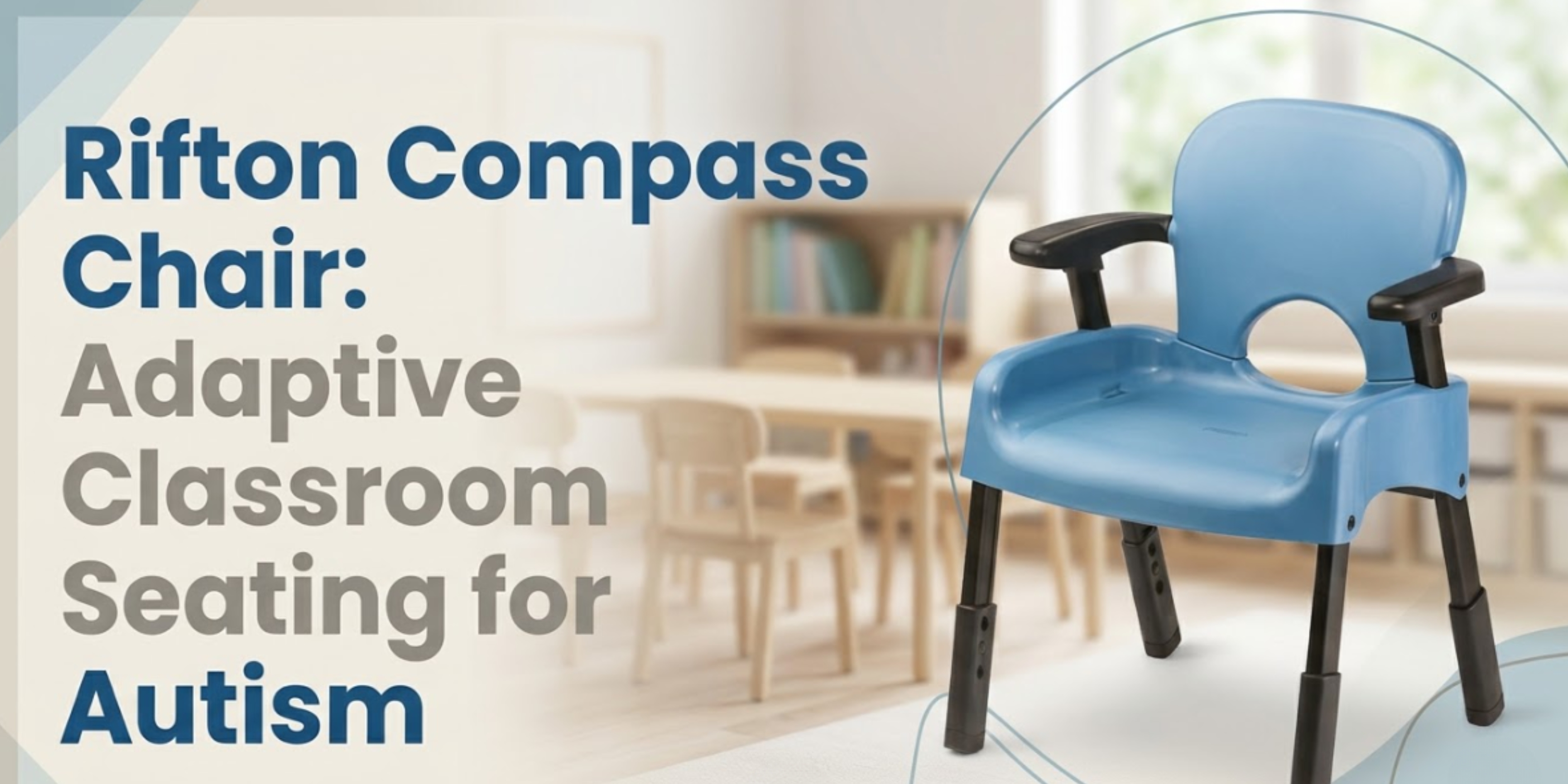
Choosing classroom seating for a child with autism may involve more than finding a comfortable chair. The right seating option may provide appropriate physical boundaries, support, and positioning while fitting naturally into the classroom environment. The Rifton Compass Chair is an adaptive classroom chair designed with a supportive seat, armrests, contoured back, and adjustable legs. Available in five sizes, it is designed for children and adults across a range of user sizes. This guide explains the Compass Chair’s features, sizing considerations, potential classroom applications, and factors educators and families may consider when evaluating adaptive seating for a special education classroom.
A classroom chair is more than a place to sit. For some students, the way a chair supports the body and defines personal space may affect how comfortably they participate in classroom activities.
Autistic students have diverse sensory, communication, motor, and learning needs.. Because of this variation, there is no single classroom seating solution that is appropriate for every child with autism. Rifton's educational article on the Compass Chair also emphasizes the importance of considering individual needs when evaluating seating interventions.
In a special education classroom, seating may be considered alongside other classroom accommodations. Depending on the student's individual needs, educators and families may look at factors such as the following:
The goal should not simply be to make a student "sit still." Instead, seating should be considered as one part of creating an accessible classroom environment that allows the student to participate in age-appropriate learning activities.
Rifton's original article describes a classroom example in which an educator used a Compass Chair as one component of a broader educational approach. Importantly, the article does not attribute the student's progress to the chair alone.
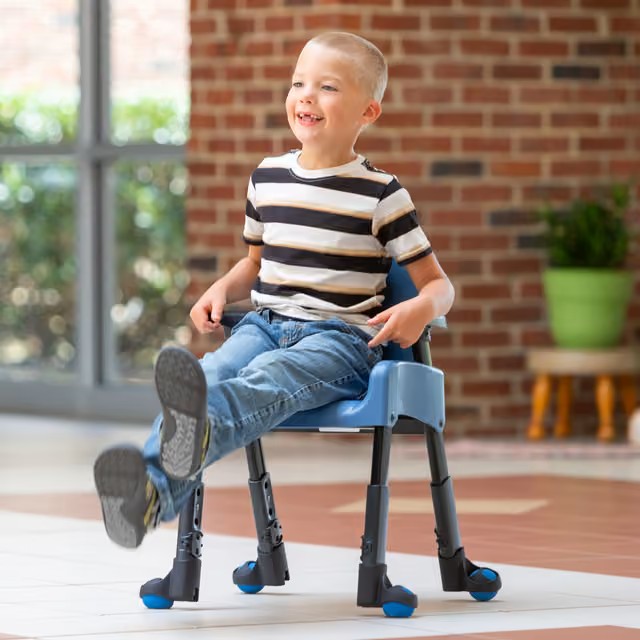
The Rifton Compass Chair is an adaptive classroom chair designed for students and adults who may benefit from additional support while seated.
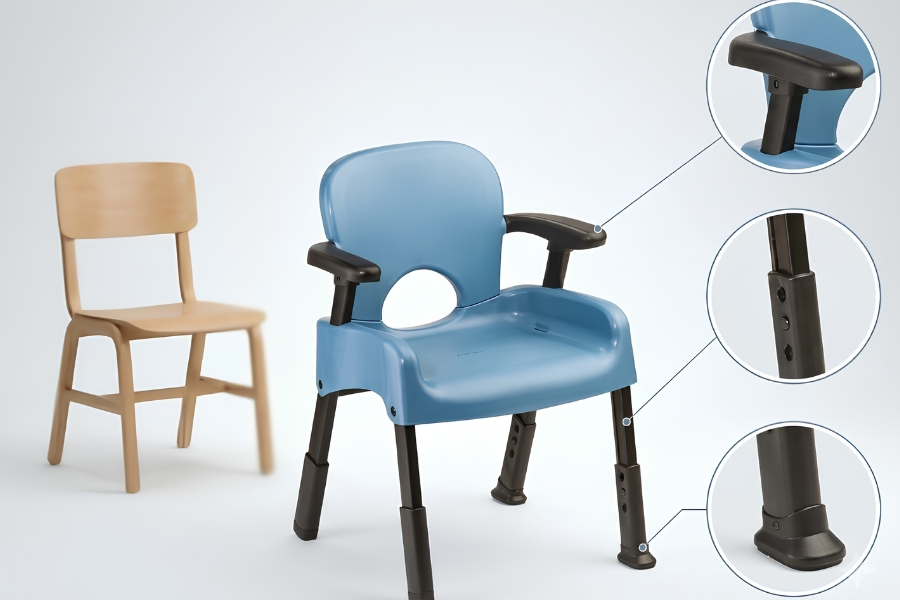
Rifton describes the Compass Chair as adaptive seating for the classroom. Its design combines a supportive seat, armrests, a stable frame, and a contoured back while maintaining an appearance that can blend with conventional classroom furniture.
The chair is available in five sizes, ranging from Size 1 through Size 5. Rifton's current specifications use overall user height and knee-to-heel measurements as general sizing guides, while also emphasizing that seat width, depth, and height need to be appropriate for the individual user.
This makes the Compass Chair a potential option for classrooms looking for special needs classroom chairs that provide more structure than a conventional classroom chair without having a highly clinical appearance.
| Feature | Rifton Compass Chair |
| Intended setting | Classroom and educational environments |
| Sizes | 5 sizes |
| Seating design | Contoured seat and back |
| Arm support | Sturdy armrests |
| Seat adjustment | Height-adjustable legs |
| Additional options | Dynamic feet, stability feet, low-friction legs, seat belt, pelvic harness, rocking chair base |
| User range | Small children through adults, depending on size |
| Design | Classroom-friendly appearance |
Specifications and available components may change, so review the current manufacturer's information before purchasing or configuring a chair.
The Compass Chair's value comes from the combination of its seating structure and available configuration options.
The seat and back are contoured to provide a more structured seating surface than many conventional classroom chairs.
Rifton states that the seat and back have a non-slip texture intended to provide additional security and stability while seated.
The chair includes sturdy armrests that provide defined sides to the seating area.
For some students, clearly defined physical boundaries may be useful when establishing their personal seating space. However, whether this is appropriate depends on the individual student's needs.
The raised sides of the seat provide lateral thigh support. According to the manufacturer's product information, these raised sides, together with the armrests, create physical boundaries around the seating area.
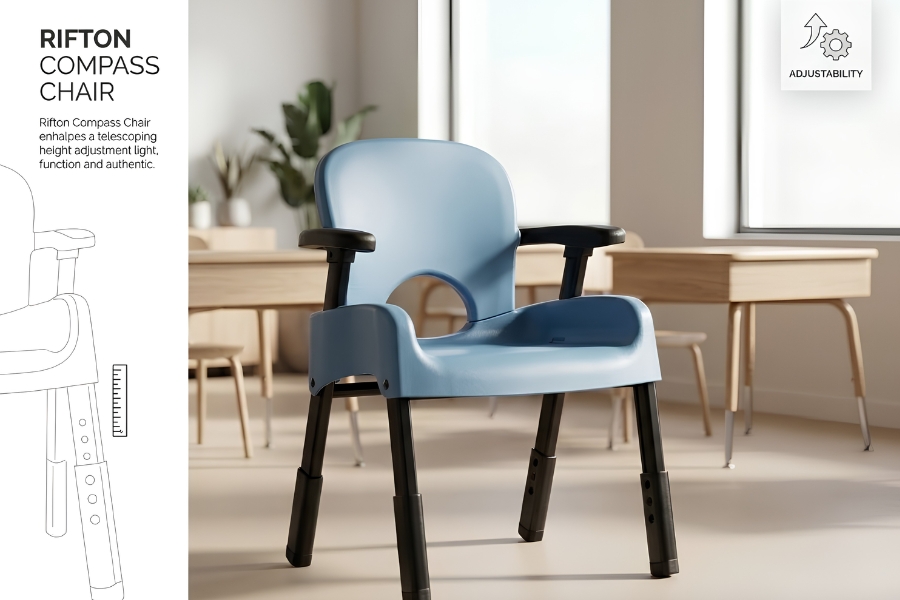
The Compass Chair has adjustable legs that allow the seat height to be changed.
This may be particularly useful when a student needs to work at different classroom tables or desks. The current Rifton model provides multiple seat-height settings within each size.
Unlike some highly specialized positioning equipment, the Compass Chair has a relatively simple appearance.
Its design is intended to blend with classroom furniture rather than making the chair look substantially different from other classroom chairs.
The current Compass Chair configuration includes additional options such as:
These components should be selected according to the student's individual requirements and used according to the manufacturer's instructions.
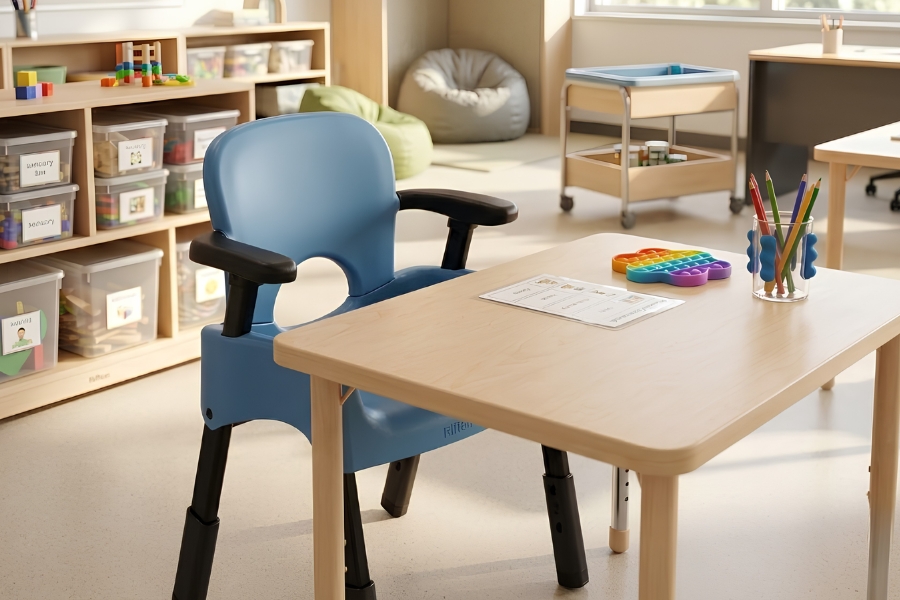
A special education classroom may include students with widely different seating and positioning needs. A conventional classroom chair may be appropriate for one student but not provide the same level of support needed by another.
The Compass Chair may be considered when a student needs a more structured seating environment while still participating at a classroom table or desk.
For example, educators may consider features such as the following:
| Classroom consideration | Compass Chair feature to review |
| Student needs defined seating boundaries | Contoured seat, raised sides and armrests |
| The student needs a specific seat height | Adjustable legs |
| Students benefit from some movement | Dynamic feet or rocking base |
| The student requires additional base stability | Stability feet |
| The chair needs to move more easily | Low-friction legs |
| The student needs additional positioning support | Optional seating components |
| The chair should blend into classroom furniture | Simple classroom-oriented design |
The chair should not be viewed as a replacement for an individualized educational plan, classroom accommodation strategy, therapy program, or professional assessment.
Instead, it may be one piece of the student's overall classroom setup.
Correct sizing is one of the most important considerations when selecting adaptive classroom seating.
Rifton currently offers five Compass Chair sizes. The manufacturer's sizing chart uses overall height and knee-to-heel measurements as general guides. Rifton also recommends checking seat width, seat depth, and seat height to make sure the chair is appropriate for the individual user.
Current Compass Chair Size Guide
| Size | Model | Approx. User Height | Maximum Working Load |
| Size 1 | R310 | 36–45 in. | 100 lb |
| Size 2 | R320 | 43–50 in. | 120 lb |
| Size 3 | R330 | 48–57 in. | 175 lb |
| Size 4 | R340 | 55–65 in. | 220 lb |
| Size 5 | R350 | 63+ in. | 250 lb |
These figures are manufacturer specifications and should be checked against the current product documentation before ordering.
What should you check before ordering?
Consider:
For students with more specific positioning requirements, an occupational therapist, physical therapist, or other qualified professional may help determine appropriate seating dimensions and configuration.
One advantage of the Compass Chair is that its configuration can be adjusted to suit different classroom situations.
Dynamic feet are designed to provide a controlled movement option. Rifton describes them as an option for students who benefit from movement and sensory input.
Stability feet enlarge the chair's base of support. They may be considered when additional stability is needed for a particular classroom setup.
Low-friction legs allow the chair to slide more easily across the floor, which may be useful when classroom furniture needs to be repositioned.
The rocking chair base provides controlled rocking movement. This is a newer configuration option for the Compass Chair.
Optional positioning components are available for the Compass Chair.
These components should not be selected simply because a child has autism. Their use should be based on the individual student's positioning requirements and the manufacturer's instructions, with appropriate professional input when needed.
A standard classroom chair may be perfectly suitable for many students. The question is whether it provides the level of support and adjustability needed by a particular student.
The Compass Chair differs from a typical classroom chair primarily through its adaptive features.
| Consideration | Standard Classroom Chair | Rifton Compass Chair |
| Adjustable seat height | Usually limited | Yes |
| Contoured seat/back | Usually limited | Yes |
| Defined lateral boundaries | Usually limited | Yes |
| Armrests | Varies | Yes |
| Multiple sizes | Varies | 5 sizes |
| Movement options | Usually limited | Optional dynamic feet/rocking base |
| Stability options | Usually limited | Optional stability feet |
| Adaptive positioning components | Usually limited | Available options |
This does not mean an adaptive chair is automatically better than a standard classroom chair. The appropriate choice depends on the individual student's needs, classroom environment, and seating goals.
Back to school planning is a useful time to review classroom seating and adaptive equipment.
Before the school year begins, families and educators may want to check:
Growth is particularly important for children. A chair that worked well during the previous school year may no longer provide the same fit as the child grows.
Rifton specifically advises selecting a model that allows for growth and checking the chair's dimensions against the individual user.
The Compass Chair may be worth considering when a student needs more structured seating than a conventional classroom chair provides.
It may be especially relevant for a student who benefits from:
However, autism alone does not determine whether a particular chair is appropriate.
Every child has different sensory, physical, communication, and learning needs. The Rifton education article also emphasizes that seating interventions should be individualized rather than treated as a one-size-fits-all solution.
For families, teachers, and special education teams evaluating classroom chairs, the most useful question may therefore be:
What seating features does this particular student need to participate comfortably and safely in classroom activities?
Once those needs are identified, the Compass Chair's size and configuration can be evaluated against them.
Medicaleshop offers the Rifton Compass Chair as part of its special needs seating selection.
Medicaleshop is a U.S.-based dealer and supplier of medical and rehabilitation equipment. Product availability, configuration, pricing, and specifications may change, so shoppers should review the current product page and manufacturer's documentation before ordering.
This guide was developed using the Rifton Compass Chair product information and product manual, along with Rifton's educational article, The Compass Chair: A Classroom Seating Option for the Child with Autism
Medical & Product Information Disclaimer
Medicaleshop is a U.S.-based dealer and supplier of medical and rehabilitation products. Medicaleshop is not a manufacturer, physician, hospital, therapist, or licensed medical provider. This article is provided for general educational and product-information purposes only and is not medical advice, diagnosis, treatment, or a recommendation that a particular seating product is appropriate for any individual.
The Rifton Compass Chair and its accessories should be selected, configured, and used according to the manufacturer's instructions and the individual user's needs. When professional assessment is appropriate, families and educators should consult a qualified healthcare or rehabilitation professional. Always review the current manufacturer's product information, sizing guidance, warnings, and instructions before use.
Frequently Asked Questions
Ans. The Rifton Compass Chair is an adaptive classroom chair designed to provide additional seating support through features such as a contoured seat and back, armrests, raised sides, and adjustable legs. It is intended for classroom use and is available in five sizes.
Ans. It may be considered for some children with autism who benefit from additional seating structure or defined physical boundaries. However, autism is a broad spectrum, and there is no single seating solution appropriate for every child. Individual needs should be considered when selecting classroom seating.
Ans. The current Compass Chair can be configured with optional movement features, including dynamic feet and a rocking chair base. Standard configurations and optional components may differ, so check the current manufacturer's specifications before ordering.
Ans. Rifton provides five sizes and recommends using the user's overall height and knee-to-heel measurement as general sizing guides. Seat width, seat depth, seat height, and user weight should also be checked before selecting a size.
Ans. Yes. The Compass Chair is specifically designed as adaptive classroom seating and is intended to blend into classroom environments. It may be used in special education settings when its features match the student's seating requirements.
Ans. No. The five available sizes extend from smaller children through adults, with the largest size intended for users 63 inches and taller and a maximum working load of 250 lb. Always verify current manufacturer specifications before selecting a size.
Ans. A special needs trust is a financial planning tool, and whether it may be used to pay for a particular product depends on the individual's circumstances, trust terms, and applicable rules. Families considering a special needs trust for adaptive equipment should consult a qualified financial or legal professional rather than relying on general product information.
Ans. No. Many students with autism may use standard classroom chairs successfully. Adaptive classroom seating should be considered based on the individual student's physical, sensory, positioning, and classroom participation needs rather than an autism diagnosis
.avif&w=3840&q=75)
.avif&w=3840&q=75)