Choosing the right Geri Chair involves more than comparing appearance or price. Reclining positions, seat dimensions, weight capacity, caster locks, upholstery, and caregiver access can all influence whether a chair suits the user and care environment. This guide explains the key features to consider when comparing Geri Chairs, also known as geriatric chairs or medical recliners. It also compares four three-position recliners available at MedicalEshop to help families, caregivers, and facility teams understand their listed features and specifications before making a selection.

A Geri Chair, short for geriatric chair, is a specialized reclining chair commonly used in healthcare, rehabilitation, long-term care, and home care environments. Unlike a standard living room recliner, a Geri Chair often includes features designed to support different seated and reclined positions, facilitate caregiver assistance, and allow movement between designated areas.
Geri Chairs are also called geriatric chairs, geri recliners, medical recliners, or positional care recliners. The term “jerry chair” is sometimes used informally to refer to the same type of seating.
Many models include three positions: upright sitting, a partially reclined position often called the TV position, and full recline. Depending on the design, features may include a padded headrest, leg rest, removable or fixed tray, side pocket, push handle, and locking casters.
Not every medical recliner has the same functions. Some models are designed primarily for general seating and supervised rest, while others are intended for specific clinical environments. It is important to review the manufacturer’s specifications and intended use rather than assuming that all Geri chairs offer identical positioning or support.

Geri Chairs may be considered for older adults and other individuals who need specialized seating or assistance with positioning. The appropriate choice depends on the person’s mobility, body measurements, ability to change positions, and the level of support required.
Potential users and care settings include:
A Geri Chair is not automatically appropriate for everyone who has difficulty sitting, standing, or walking. Some individuals may need a different seating system, additional positioning support, or a transfer aid.
Symptoms such as brain fog and irritability are not benefits that a Geri Chair is designed to treat. If these symptoms are new, persistent, or concerning, they should be discussed with a qualified healthcare professional rather than addressed through a seating change alone.
Before choosing a Geri Chair, compare its positioning options, dimensions, weight capacity, mobility features, upholstery, and included accessories. These details can help you determine whether a particular model matches the user’s requirements and the intended care setting.
Reclining positions are one of the most important differences between medical recliners.
Many three-position Geri Chairs provide:
Check how each position is activated and secured. Some chairs use a manual mechanism or locking bar, while others have different adjustment systems. Caregivers should understand how the chair operates before assisting a user.
Also, do not assume that full recline means a chair can be used as a bed or that it provides a clinically prescribed position. Positioning requirements vary by individual and care plan.
A chair should fit the person who will use it. Check the seat width, seat depth, seat height, back height, armrest dimensions, and the overall footprint.
Do not select a chair based on general descriptions such as “standard size” alone. Compare the manufacturer’s measurements with the user’s measurements and, when needed, seek guidance from a qualified seating or rehabilitation professional.
Every Geri Chair has a specified maximum user weight. Confirm that the chair’s weight capacity accommodates the intended user and follow the manufacturer’s limits.
Weight capacity is only one part of the selection process. Seat dimensions, frame design, caster configuration, and the intended use also matter. A chair with an appropriate weight rating may still be unsuitable if its seat dimensions or positioning options do not meet the user’s needs.
Many medical recliners have casters that allow caregivers to move the chair within a room or care environment. This can be useful when a chair needs to be repositioned between designated areas.
When comparing mobility features, check:
Locking casters do not make every transfer safe by themselves. Follow the chair’s instructions and the care plan when helping someone sit down, stand up, or change position. Secure the chair as directed before transfers or seated use, and do not move an occupied chair unless the manufacturer permits it and the caregiver has been trained to do so.
Medical recliners are often used in environments where routine cleaning is important. Vinyl upholstery may be easier to wipe down than some fabric materials, but cleaning requirements differ by product.
Before buying, check whether the upholstery is compatible with the cleaning and disinfection products used in your setting. Follow the manufacturer’s instructions for approved cleaners, contact times, and maintenance.
Also consider removable side panels, accessible surfaces, upholstery durability, and the availability of replacement parts. These features may influence how practical a chair is for frequent use.
Accessories can make a chair more suitable for its intended purpose, but included features vary by model.
Consider how each feature will be used in everyday care. A removable tray may be useful in one setting, while another environment may require a different arrangement. Accessories should not interfere with transfers or be used in ways that are inconsistent with the manufacturer’s instructions.
The right chair depends on the user, the care environment, and the tasks the chair needs to support. Use the following checklist when comparing options.
| Selection factor | What to check |
| User measurements | Seat width, depth, height, and back support |
| Reclining needs | Upright, partial recline, and full-recline options |
| Weight capacity | Manufacturer’s stated maximum user weight |
| Caregiver access | Push handle, armrests, footrest design, and positioning controls |
| Mobility | Caster configuration and locking mechanism |
| Cleaning | Upholstery material and approved cleaning methods |
| Accessories | Tray, headrest, side pocket, and other included features |
| Room and doorway fit | Overall width, depth, and clearance |
| Intended environment | Home care, long-term care, rehabilitation, or a specific clinical use |
| Budget and upkeep | Purchase cost, maintenance, replacement parts, and warranty |
For home care, measure the room and doorway before ordering. Leave enough space for the chair to recline fully and for caregivers to assist the user. In a facility, consider how the chair will be cleaned, stored, and moved within the designated area.
For individuals who need specialized positioning, have difficulty maintaining an upright posture, or require assistance with transfers, consult an appropriately qualified healthcare or rehabilitation professional before selecting a chair.
MedicalEshop offers several three-position medical recliners with different dimensions, weight capacities, and features. The following comparison focuses on the four specified models. Product specifications can change, so confirm the current listing and manufacturer documentation before ordering.
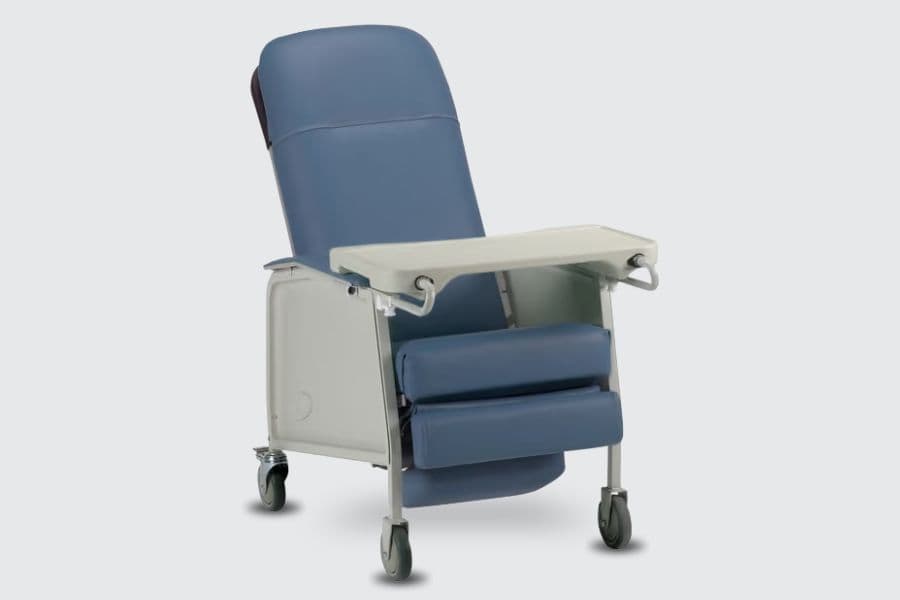
The Invacare Traditional Three Position Recliner is designed for day rooms, resident rooms, rehabilitation facilities, and home care environments.
Listed features include:
Key specifications:
| Specification | Listed details |
| Seat width | 19 inches |
| Seat depth | 19.5 inches |
| Seat-to-floor height | 21.5 inches |
| Overall dimensions | 24.25" W × 40" D × 47" H |
| Product weight | 73 lb |
| Weight capacity | 250 lb |
Consider this model if: You need a three-position recliner with a listed overlap tray, articulating headrest, and push handle. Check its seat width and weight capacity against the intended user’s measurements and needs.
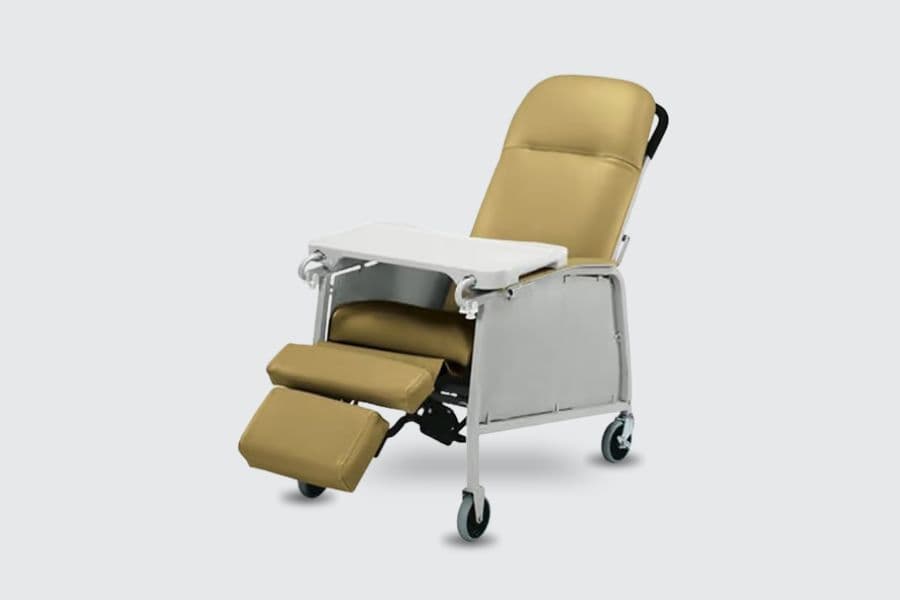
The Lumex Three Position Recliner is designed for healthcare and extended-care seating environments. Its product information highlights positioning options, an articulating headrest, and a molded activity table.
Listed features include:
Key specification:
| Specification | Listed details |
| Weight capacity | 250 lb |
Consider this model if: You want a three-position recliner with a molded activity table and an articulating headrest. Review the current product listing and manufacturer documentation for any additional dimensions or requirements needed to confirm fit.
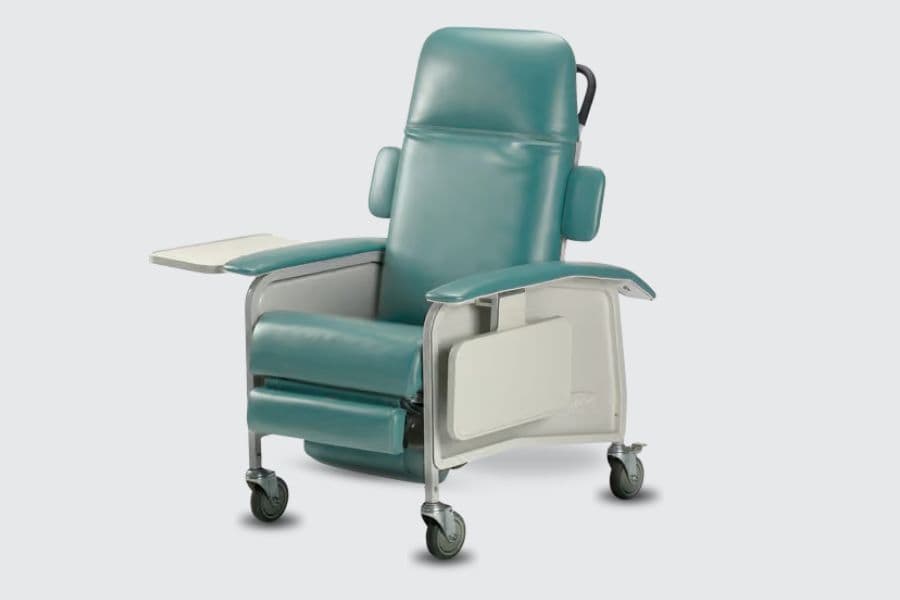
The Invacare Clinical Three Position Recliner is listed as a clinical seating option with upright, leg-elevated, and full-recline positions. Its listing describes features for clinical environments, including fluid-resistant vinyl upholstery and side tables.
Listed features include:
Key specifications shown on the MedicalEshop listing:
| Specification | Listed details |
| Overall dimensions | 30.75" W × 38" D × 49" H |
| Seat width | 31 inches |
| Seat depth | 19.5 inches |
| Seat-to-floor height | 22 inches |
| Product weight | 89 lb |
| Weight capacity | 250 lb |
Important specification note: The listed 31-inch seat width and some clinical positioning details should be confirmed with MedicalEshop and the manufacturer before ordering. The product listing also describes specialized clinical positioning, so verify the current manufacturer instructions and intended use with the supplier and appropriate clinical personnel. Do not assume that a chair is suitable for a particular medical procedure based on its product name alone.
There is no single best Geri Chair for every user or setting. The most suitable option is the one whose dimensions, weight capacity, positioning options, accessories, and intended use match the individual’s needs.
Use these points as a starting point rather than as a substitute for an individual seating assessment.
A Geri Chair is a seating product, not a complete fall-prevention or pressure-injury prevention solution. Safe use depends on the individual, the environment, the chair’s condition, and the care plan.
Keep these considerations in mind:
The National Institute on Aging and the Centers for Disease Control and Prevention provide general guidance on reducing fall risks, including making living spaces safer and discussing individual risks with healthcare professionals. A Geri Chair should be considered as one part of a broader care plan when appropriate, not as a guarantee against falls or injuries.
Choosing a Geri Chair starts with understanding the user’s seating needs, measurements, positioning requirements, and care environment. Comparing reclining positions, weight capacity, caster locks, upholstery, and included accessories can help narrow the options.
MedicalEshop offers the Invacare Traditional Three Position Recliner, Medline ComfortEZ 3-Position Recliner, Lumex Three Position Recliner, and Invacare Clinical Three Position Recliner. Review each product’s specifications and intended use before making a decision. If specialized positioning or transfer assistance is needed, consult a qualified healthcare or rehabilitation professional.
Visit MedicalEshop to review the available product details and find a recliner that aligns with your care requirements.
MedicalEshop is a U.S.-based dealer and supplier of home medical equipment, rehabilitation products, mobility aids, and special-needs products. MedicalEshop is not a physician, hospital, or licensed medical provider. This article is intended for general educational purposes only and does not provide medical advice, diagnosis, or treatment recommendations. Geri Chair suitability depends on individual needs, product specifications, and the intended care setting. Consult an appropriately qualified healthcare or rehabilitation professional for individualized seating, positioning, transfer, or skin-care guidance. Always follow the manufacturer's instructions for product use, cleaning, maintenance, and safety.
Product features and specifications are based on the available MedicalEshop listings and product literature. Confirm current specifications and intended use with the supplier or manufacturer before purchasing.
Frequently Asked Questions
Ans. A Geri Chair is a specialized reclining chair commonly used in healthcare, rehabilitation, long-term care, and home care settings. Depending on the model, it may provide multiple reclining positions, a leg rest, caregiver mobility features, and accessories such as a tray or headrest.
Ans. A regular recliner is generally designed for residential relaxation. A Geri Chair is typically designed for care environments and may include features such as locking casters, caregiver push handles, multiple reclining positions, and removable components for cleaning. Features vary by model, so compare specifications before choosing.
Ans. No. Although the name refers to geriatric seating, these chairs may be used by other individuals who need specialized reclining seating. Suitability depends on the person’s measurements, mobility, positioning needs, and the chair’s intended use.
Ans. A three-position recliner generally offers three defined positions, such as upright, TV, and full recline. An infinite-position recliner typically allows a wider range of adjustment. The actual positions and controls depend on the model, so check the manufacturer’s product information.
Ans. Compare the user’s measurements with the chair’s seat width, seat depth, seat height, back dimensions, and armrest configuration. Check the overall chair dimensions and fully reclined length against the available room space. Seek professional seating guidance if the user has specialized positioning needs.
Ans. Choose a chair whose manufacturer-listed weight capacity accommodates the intended user. Also consider seat dimensions, frame design, and the chair’s intended use. For example, the Medline ComfortEZ is listed with a 300 lb capacity, while the Invacare Traditional and Lumex Three Position Recliners are listed at 250 lb.
Ans. Some Geri Chairs have casters and push handles for repositioning. However, the safe method for moving the chair depends on the specific model and whether it is occupied. Follow the manufacturer’s instructions and facility procedures, and use trained assistance when required.
Ans. No chair should be assumed to prevent pressure injuries or falls on its own. Risk depends on factors such as mobility, skin condition, positioning, transfers, and the surrounding environment. Follow individualized professional guidance for seating, repositioning, skin care, and fall-risk management.
Ans. A Geri Chair is designed for seating and reclining, not to treat brain fog, irritability, or their underlying causes. If these symptoms are new, persistent, or worsening, consult a qualified healthcare professional to determine what evaluation or support may be appropriate.
Ans. Geri Chairs may also be called geriatric chairs, geri recliners, medical recliners, or positional care recliners. Terminology varies across manufacturers and suppliers, so it is important to check the actual product features rather than relying on the name alone.

