Choosing the right pediatric walker involves more than selecting a smaller version of an adult walker. Children may need different levels of balance, positioning, weight-bearing, and trunk support depending on their mobility needs. Options range from standard walkers and two-wheel walkers to posterior walkers, forearm walkers, and pediatric gait trainers with additional positioning supports. This guide explains the key factors to consider, including size, fit, handle height, adaptability, wheel configuration, storage, travel, and intended environment. It also compares common pediatric walker types and highlights gait trainers and walkers available through MedicalEshop to help families explore appropriate mobility equipment.
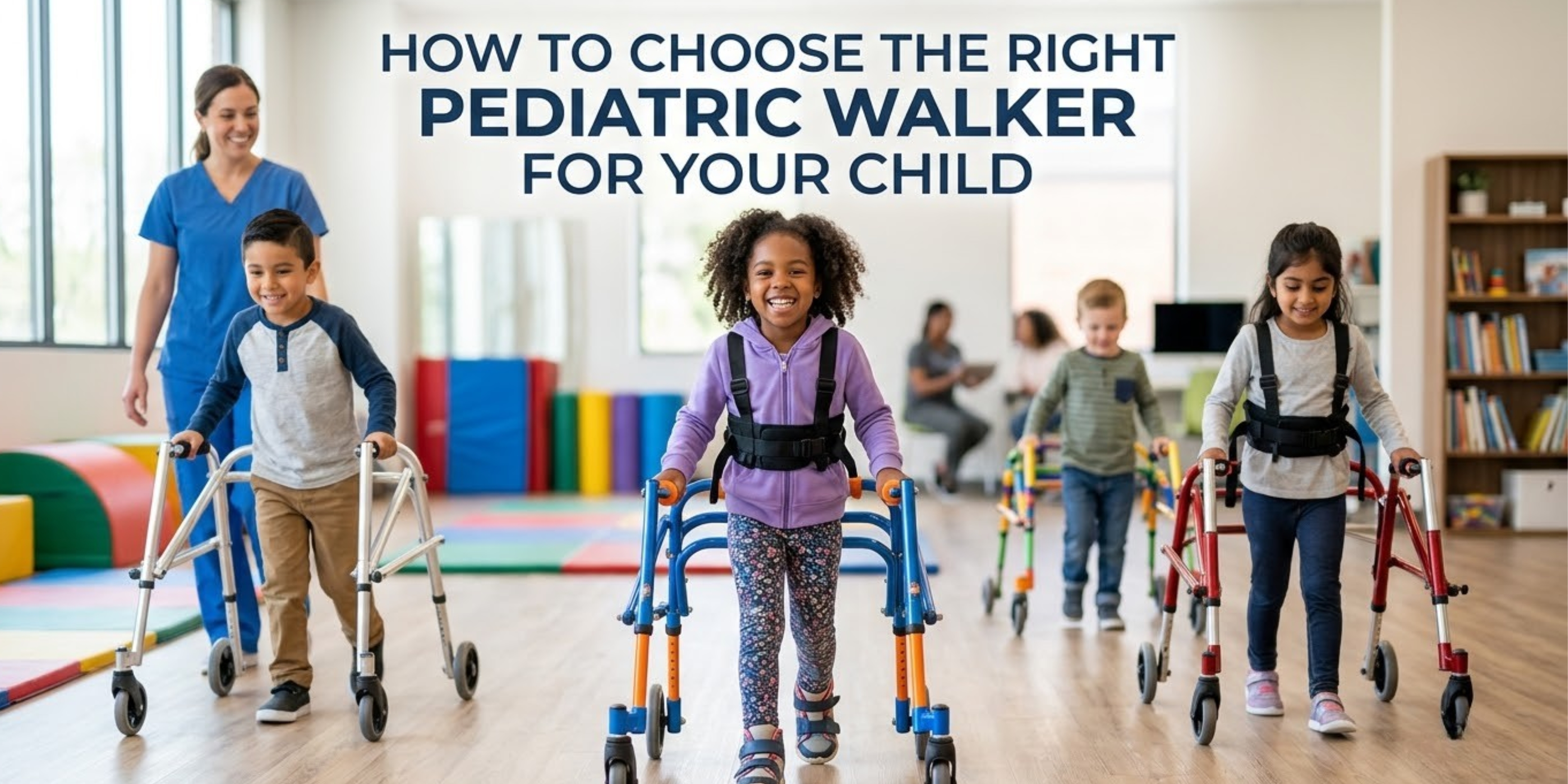
A pediatric walker is a mobility aid designed around the size and functional needs of children who require additional support while walking. Compared with many standard adult walkers, pediatric models may offer smaller dimensions, adjustable components, and configurations designed for different mobility needs.
A pediatric walker may be considered for a child who needs additional support for balance or stability while walking. Depending on the child's abilities, a walker may provide basic hand support, Depending on the design and configuration, a gait trainer may provide additional trunk, pelvic, arm, or lower-extremity support.
The important point is that there is no single best pediatric walker for every child. The appropriate equipment depends on the child's measurements, ability to bear weight, balance, strength, hand function, posture, environment, and intended use.
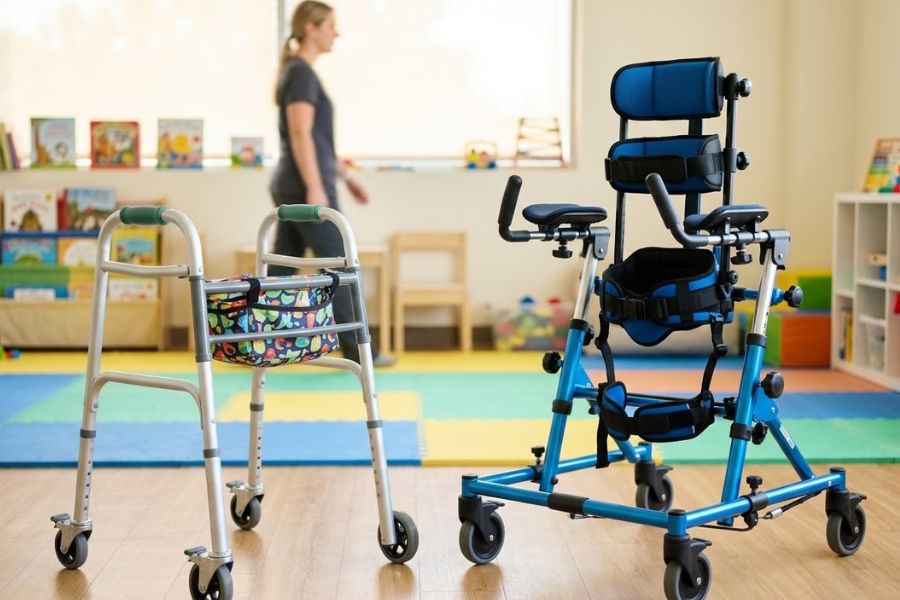
A walker generally provides a frame and hand support, while a gait trainer can be configured with additional supports for positioning and stability. Although the terms are sometimes used interchangeably, a pediatric walker and gait trainer are not necessarily the same.
A standard pediatric walker generally provides a frame and hand supports that a child uses while taking steps. A gait trainer may provide additional support around the trunk, pelvis, hips, legs, or arms, depending on its configuration.
Gait trainers are supportive walking aids for children who need help walking and may need more support than a conventional walker provides.
A simplified comparison can help:
| Feature | Pediatric Walker | Gait Trainer |
| Basic hand support | Usually | Usually |
| Balance support | Yes | Yes |
| Additional positioning | Limited to model | Often available |
| Trunk/pelvic support | Model-dependent | More commonly available |
| Support accessories | May be limited | Often configurable |
| Common use considerations | Children who may need a simpler walking-support configuration | Children who may benefit from additional positioning or support options |
| Professional fitting | May be helpful | Particularly important for complex configurations |
This does not mean a gait trainer is automatically better than a walker. More support is not necessarily better support. The goal is to identify equipment that provides the amount and type of assistance appropriate for the child's current needs.
Before comparing brands or features, start with the child.
Ask what the child needs help with during walking.
For example:
These questions can help narrow the type of equipment to consider.
For children with more complex positioning or mobility needs, a pediatric physical therapist or other qualified healthcare professional can assess the child's abilities and recommend an appropriate mobility device.
Fit is one of the most important factors when choosing a pediatric walker.
A walker that is too high, too low, too wide, or otherwise poorly matched to the child may be uncomfortable or difficult to use.
Depending on the walker, relevant measurements may include the following:
The exact measurements required vary by manufacturer and product. Do not rely on age alone when selecting a size. Children of the same age may have very different heights, body proportions, and mobility requirements.
Pediatric walkers and gait trainers have manufacturer-specified weight limits or maximum working loads.
The child's current weight should be checked against the manufacturer's specifications before selecting equipment. If the child's weight is close to the listed limit, review the manufacturer's sizing guidance and consult a qualified professional if you are unsure which size or configuration is appropriate.
Because children grow and their mobility needs may change, adjustability may be an important feature to consider.
Depending on the model, adjustable features may include the following:
Adjustability may allow a walker or gait trainer to accommodate changes in the child's size or functional needs.
However, an adjustable product is not automatically the right product. Adjustments still need to be made according to manufacturer instructions and, when appropriate, professional recommendations.
Handle grips are an important consideration for children who use a traditional walker.
The handle or upper-extremity support should be compatible with the child's hand strength, grip, and ability to control the device.
If conventional hand grips are difficult to use, consider whether the walker or gait trainer offers alternatives such as the following:
This illustrates why comparing the configuration of the entire mobility system may be more useful than comparing walker frames alone.
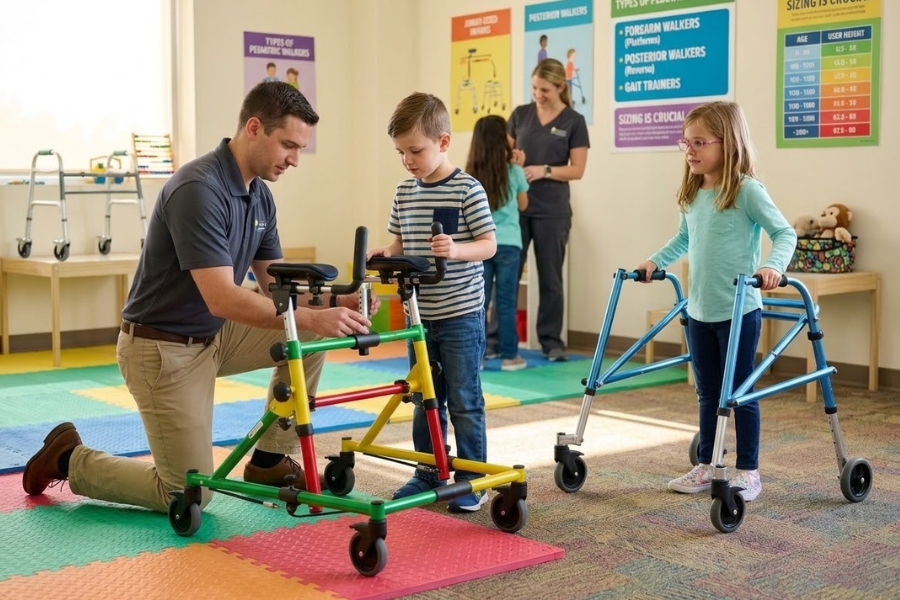
Different walker designs provide different types of support and movement.
A standard walker generally consists of a lightweight frame with hand grips and four contact points with the floor.
It may be appropriate for children who need basic support and are able to manage the frame according to its design.
Common characteristics may include the following:
However, a standard walker may not provide the positioning support needed by a child who requires additional trunk, pelvic, or lower-extremity assistance.
A two-wheel walker has wheels on the front legs and fixed or non-wheeled rear legs.
This configuration may reduce the need to lift the entire walker while allowing the user to move it forward.
When considering a two-wheel walker, evaluate whether the child can safely manage the walker and maintain appropriate control during movement.
A four-wheel walker, sometimes called a rollator, uses four wheels and may offer greater maneuverability. However, because the walker rolls continuously, the child needs sufficient control to manage its movement.
For pediatric users, do not assume that a four-wheel walker is appropriate simply because it is easier to roll. The child's balance, strength, coordination, and ability to control the device should be considered.
Because four-wheel models roll more freely, the child should be able to control the device appropriately for the model and intended environment. Follow the manufacturer's instructions and seek professional guidance when needed
A forearm walker uses platforms or supports under the forearms rather than relying entirely on hand grips.
This may be worth considering for children who have difficulty gripping conventional handles or who require a different upper-extremity support arrangement.
A reverse walker, also called a posterior walker, is positioned behind the child rather than in front.
This configuration can leave the area in front of the child more open and may be preferred for some children based on their walking pattern and support requirements.
Posterior walkers are devices positioned behind the child, and it is noted that walkers and gait trainers can be selected based on the child's mobility needs.
Some pediatric gait trainers offer additional positioning and support options that may not be available on a basic walker
Depending on the model, features may include the following:
If the walker will be used outside, consider the surfaces the child will encounter.
Think about:
A walker designed primarily for smooth indoor flooring may not be the best choice for outdoor environments.
For example, manufacturer specifications for products such as the R82 Crocodile describe different wheel and caster configurations. Review the manufacturer's specifications to determine whether a particular model is designed for the environments where it will be used.
Size should be based on the manufacturer's measurements rather than the label alone.
Terms such as junior-sized or infant-sized may vary between manufacturers. Always check:
Again, a pediatric rehabilitation walker should not be confused with a wheeled infant baby walker.
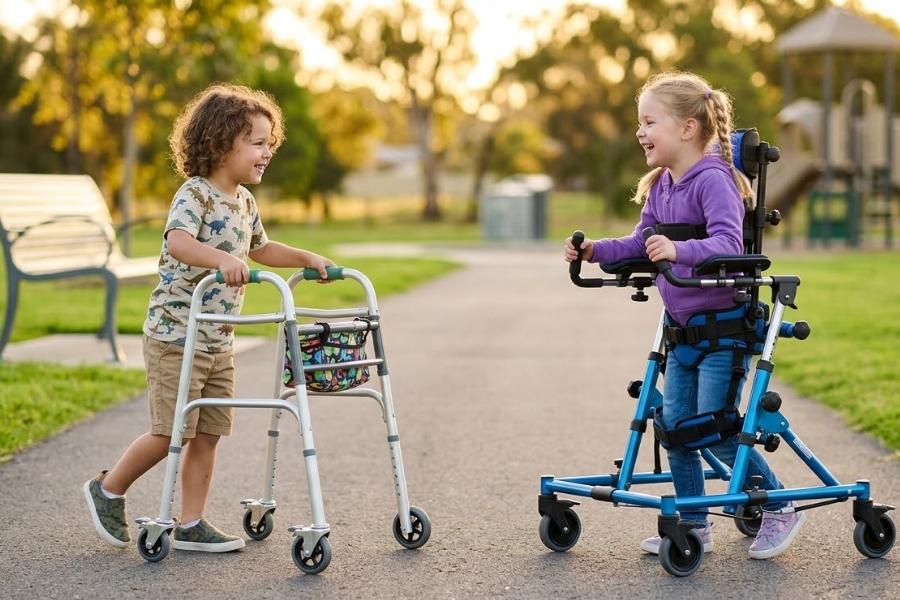
Age alone is not enough to determine walker size. Compare the child's measurements with the manufacturer's sizing information for the specific model.
A practical sizing checklist
| What to measure | Why it matters |
| Height | Helps identify the appropriate product size |
| Elbow-to-floor height | Important for many gait trainers and forearm supports |
| Wrist-to-floor height | May help with certain handle configurations |
| Hip width | Relevant to some positioning components |
| Chest circumference | May be needed for chest prompts or supports |
| Weight | Must remain within the manufacturer's weight capacity |
| Leg dimensions | May matter for lower-extremity positioning accessories |
Rifton specifically uses elbow-to-floor height when selecting Pacer frame sizes. Its published ranges vary from 15½ to 20½ inches for the Mini to 34-49 inches for the XL.
Always use the manufacturer's current sizing guide for the specific model. A therapist or qualified professional can also help assess whether the walker is positioned appropriately for the child's functional needs.
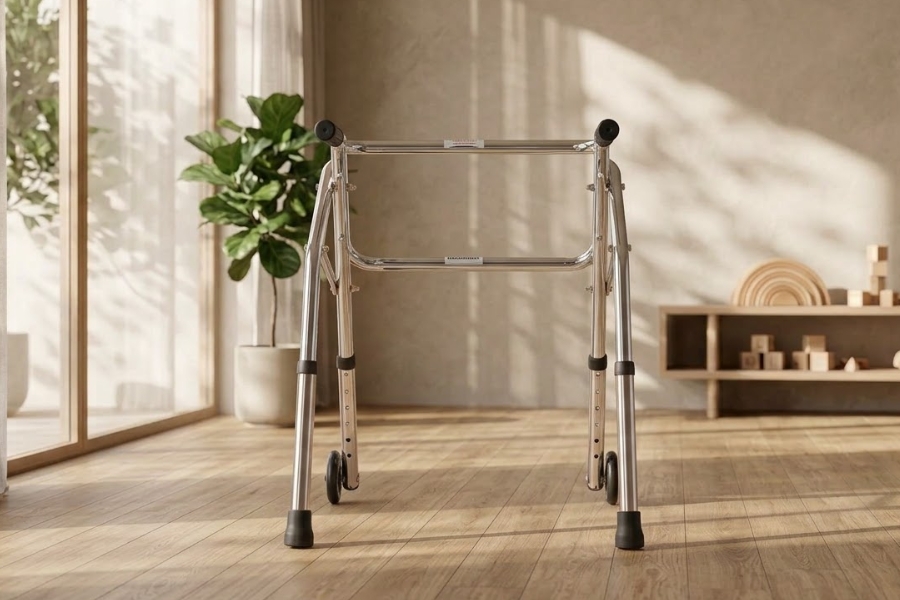
Once you have identified the type and size, consider how the walker will fit into everyday life.
A walker used at home, school, therapy sessions, and while traveling may need to be easy to fold, transport, and store.
Consider:
Some pediatric walkers are specifically designed to fold for transportation or storage.
Wheel Configuration
Wheel configuration affects how the walker moves.
Depending on the model, you may encounter the following:
The right configuration depends on the child's abilities and the intended environment.
Some models include braking or wheel-control features. Their purpose and appropriate use vary by device, so caregivers should follow the manufacturer's instructions and seek professional guidance when the equipment is being used for activities beyond walking.
Do not assume that a particular brake or wheel configuration is appropriate for a child without considering the complete product setup.
Accessories may change how a gait trainer supports and positions the child. Accessory selection includes the following:
The important question is not “How many accessories does it have?” but rather “Does the equipment provide the type of support the child needs?”
MedicalEshop's Gait Trainers and Walkers collection includes pediatric mobility options from brands such as Rifton, R82, Inspired by Drive, Leckey, Circle Specialty, and others. The current collection includes both basic walkers and more configurable gait-training systems.
Here are several examples to explore:
| Product | Type | Key product characteristic |
| Inspired by Drive Nimbo Walker | Posterior walker | A pediatric posterior-walker option available through MedicalEshop |
| R82 Crocodile Gait Trainer | Reverse/posterior gait trainer | Designed as a pediatric gait-training option with adjustable features |
| Rifton Pacer Gait Trainer | Gait trainer | Available in multiple sizes and with a broad range of positioning accessories |
| Drive Medical Moxie GT Gait Trainer | Pediatric gait trainer | Available through MedicalEshop's pediatric walking-aid collection |
| KidWalk II Dynamic Gait Trainer | Dynamic gait trainer | Designed for pediatric mobility and gait-training applications |
The products above are examples, not universal recommendations. MedicalEshop is a supplier of medical and rehabilitation equipment, not a physician or physical therapy provider. Product selection should be based on the child's measurements, abilities, intended environment, manufacturer's specifications, and, when appropriate, guidance from a qualified healthcare professional.
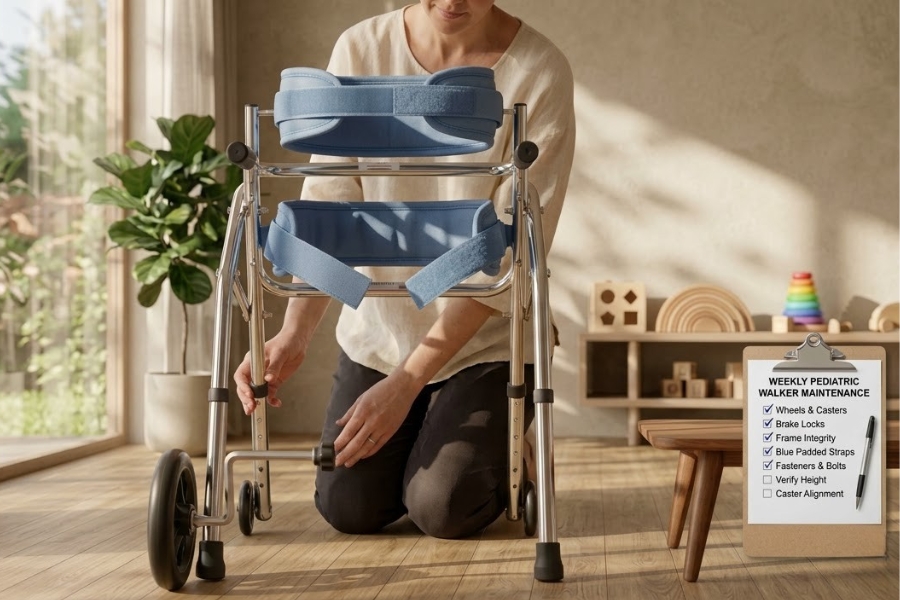
Choosing an appropriate walker is only part of the process. The equipment should also be checked regularly.
Before use, inspect:
Check that height and other adjustable components remain properly secured.
For a gait trainer with positioning accessories, make sure the accessories are installed and adjusted according to the manufacturer's instructions.
Children grow, and their mobility needs may change.
Consider reviewing the fit when:
A walker that fit well several months ago may not remain appropriate as the child grows.
If you notice damaged components, loose hardware, malfunctioning brakes, or other safety concerns, stop using the equipment until it has been evaluated according to the manufacturer's guidance.
Choosing the right pediatric walker depends on the child’s size, mobility abilities, support needs, hand function, positioning, and everyday environment. Options range from standard, two-wheel, four-wheel, and forearm walkers to more configurable gait trainers for children requiring additional support.
Before choosing a mobility aid, compare the child’s measurements with the manufacturer’s guidelines and review weight capacity, adjustability, configuration, accessories, and intended use. For complex mobility needs, professional guidance may also be appropriate.
Explore MedicalEshop’s pediatric walkers, gait trainers, and mobility accessories to compare options and find a solution that fits your child’s needs.
MedicalEshop is a U.S.-based dealer and supplier of medical and rehabilitation equipment and is not a physician, physical therapist, hospital, or licensed medical provider. Product selection and setup should follow manufacturer instructions and, when appropriate, the recommendations of a qualified healthcare professional.
1. American Academy of Pediatrics (AAP)
2. Centers for Disease Control and Prevention (CDC)
Frequently Asked Questions
Ans. There is no single best pediatric walker for every child. The appropriate choice depends on the child's measurements, balance, weight-bearing ability, hand function, posture, support requirements, environment, and intended use. A qualified pediatric rehabilitation professional can help determine which type and configuration may be appropriate.
Ans. A pediatric walker generally provides basic support for balance and walking, while a gait trainer may provide additional trunk, pelvic, hip, arm, or lower-extremity support. The amount of support needed depends on the child's individual mobility abilities.
Ans. Not necessarily. A posterior walker is positioned behind the child, while an anterior walker is positioned in front. The appropriate configuration depends on the child's functional abilities, posture, balance, and support needs.
Ans. There is no single age at which every child should begin using a pediatric walker. Walker selection is generally based on the child's mobility abilities and measurements rather than age alone.If you are concerned about your child's walking development, discuss those concerns with the child's pediatrician or an appropriate pediatric rehabilitation professional. CDC guidance recommends acting early when a child is not meeting developmental milestones or has lost skills they previously had.
Ans. Measurements vary by product. They may include height, elbow-to-floor height, wrist-to-floor height, hip width, chest dimensions, leg dimensions, and weight. Always use the specific manufacturer's sizing instructions. For example, Rifton uses elbow-to-floor height as a key measurement for Pacer gait trainer sizing.
Ans. Some pediatric walkers and gait trainers have adjustable components that accommodate changes in the child's size. However, the available adjustment range varies by model. Check the manufacturer's sizing range and weight capacity before purchasing.
Ans. The Inspired by Drive Nimbo Walker is a pediatric posterior walker listed by MedicalEshop. Posterior walkers are positioned behind the child and are one of the common configurations used for pediatric walking support.
Ans. A forearm walker may be an option for some children who have difficulty using conventional hand grips. However, the appropriate configuration depends on the child's upper-extremity function, posture, balance, and overall mobility needs. A professional assessment may help determine whether forearm support is appropriate.
Ans. Pediatric rehabilitation walkers and gait trainers are designed for children who require walking support, but safe use depends on appropriate selection, fit, setup, and supervision according to the product's instructions. Traditional wheeled baby walkers are different. The American Academy of Pediatrics recommends against mobile baby walkers because of injury risks.
Ans. Some models may be suitable for outdoor use, but this depends on the manufacturer's design and specifications. Consider wheel size, caster configuration, surface conditions, product stability, and the child's ability to control the device. Never assume that a walker designed for indoor use is appropriate for uneven outdoor terrain.
Ans. There is no standard length of time. Some children may use a walker temporarily while developing walking skills, while others may use mobility equipment for longer periods. Alberta Health Services notes that walkers and gait trainers may be used for different durations depending on a child's mobility needs.
.avif&w=3840&q=75)
.avif&w=3840&q=75)